

Speech by Birutė Mar, actress and director of Solo Theatre, delivered at the Parliament of the Republic of Lithuania on June 14, 2025, during the commemoration of the Days of Mourning and Hope and the Day of Occupation and Genocide.
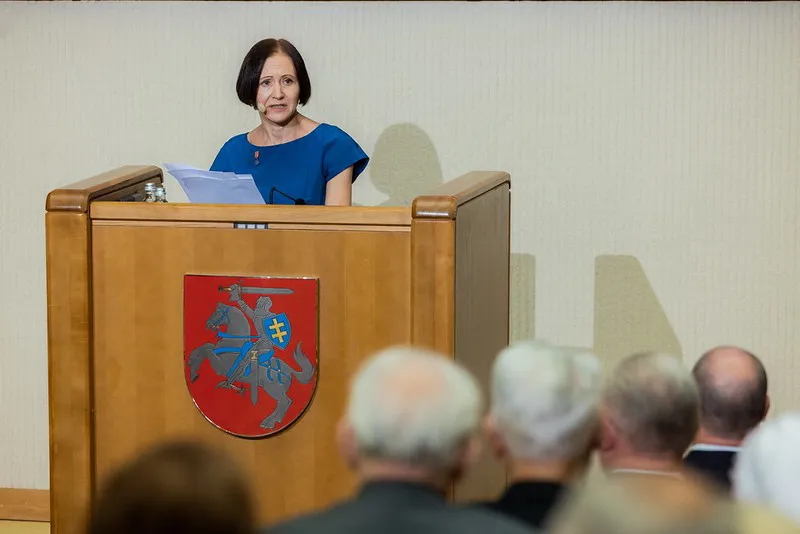
I am grateful to be invited today to speak on my own behalf as well. Before that, I read poems by deportees – Juozas Butkevičius, Izabelė Baublytė-Balčiūnienė, Vytenis Grabauskas – written in distant Siberia, in the steppes of Kazakhstan, in the Mordovia camps, on the ice islands of the Laptev Sea… The final verses are my own, written while listening to my parents’ stories about their childhood in exile.
My parents were also deportees from the islands of the Laptev Sea, exiled on that fateful June 14, 1941. They were deported as children, like many others, and fate led them to grow up together in the same yurt on Tit-Ary Island, in the northernmost and most remote places of Lithuanian exile… Based on my parents’ childhood memories and the stories of other deportees, I created the performance “Ice Children”, whose heroine is a four-year-old girl travelling by train into the unknown, just as my mother, Jūratė Vaičiūnaitė, once was. I was especially moved by her memory of a moment in the train, which carried many Lithuanians eastward, while the girl, of course, still did not understand where they were being taken. While playing, a small button fell off her dress and accidentally rolled onto the railway tracks. She cried inconsolably over that button, and later kept dreaming of returning to find it… When my mother told me this, that red child’s lost button on the tracks immediately appeared to me as an incredibly fragile and painful metaphor – as if it were the fate of Lithuania itself at that time. And in that train, my mother said, seeing the many overcrowded wagons moving in one direction, people thought that all of Lithuania was being taken away…
I conclude the performance “Ice Children” with my mother’s words, which she said many years later and which have stayed with me ever since. During my parents’ golden wedding anniversary, when the priest in the church blessed them and asked: “And who made the two of you so beautiful?”, my mother replied at that very moment: “Siberia, we are Siberian children.”
My mother is already in heaven, but her boundless strength remains with me. And as I experience the performance myself each time, I draw strength from all those people whose fragments of life and memories I have woven into the play. It seems to me that the hardest fate fell not to the parents, who were still children then, who did not yet know what is good or evil, but to my grandparents, teachers who were deported in their mature years, whose youth had passed in independent Lithuania, who worked and built that independent Lithuania – both of them taught in schools in the Kupiškis region. My grandfather, Klemensas Vaičiūnas, was a school principal and at that time was building a new school in Šeduva. According to my mother, her parents’ generation – people of independence – were completely different. “Their values were different,” she used to say. Honesty. Inner dignity. “Village lanterns…” is what teachers were called then. In other words, “bearers of light” – not without reason, of course, they were among the first to be deported so that they would no longer illuminate others. That is why those lanterns could not understand at all why they were being taken away. And so they did not run – they believed they were innocent and would soon return…
And they returned to Lithuania after twenty-two years, in 1963. Of course, not all of them returned… My father then spent another three years in the Russian army, on a submarine near Sakhalin. His words: “When I returned to my homeland and stepped out of the train, I knelt down, took a handful of Lithuanian soil, and, unable to hold back, burst into tears”…
I remember what a miracle the 1990s and independence were for my parents. It became, at last, their fully lived life. They did not miss a single rally, stood day and night near the Parliament during the events of January 13, took part as observers in all elections and votes, carried ballots everywhere. Whenever the Lithuanian national anthem, “Lithuania, Dear Land,” or songs and poems about the homeland were heard, tears would appear in my mother’s eyes; she always wore traditional national dress. Later, however, my mother could not understand how quickly people forgot the price of freedom. What weighed most heavily on her, as life improved, was people’s dissatisfaction with trivial matters and internal quarrels. She kept repeating: how can one, in the name of comfort, forget what is most important? I was most deeply moved by my mother’s words, spoken during a period of crisis when pension cuts for seniors were being discussed: “I can donate my pension, as long as it helps Lithuania become better…”
And I wondered: what would my parents say standing here today? A few days ago, I asked my ninety-year-old father, Algirdas Marcinkevičius, exactly that – what he would say if he had to speak at this commemoration. He answered immediately, formulating it very clearly and concisely:
“I would say that without the past, there is no future. Many people now say: Let us forget what was. But we cannot forget, because THE TRAGEDY OF THE PAST IS OUR TEACHER… And today, living in joy, we must remember the past and think about why it happened, so that it would not happen again…”
THE TRAGEDY OF THE PAST IS OUR TEACHER.
Reflecting on this, I would like to quote words that feel especially relevant today, spoken by the heroine of my other performance, the early 20th-century Lithuanian intellectual and writer Marija Pečkauskaitė-Šatrijos Ragana:
“What kind of nation are we, if for a wounded ambition we go to the enemy and smear our own people with mud? How can culture rise when party struggle reigns everywhere: what one side builds, the other destroys! /…/ They quarrel not for the greater good of Lithuania, but for wounded egoism! /…/ When foreigners only sought their own benefit, we understood it – we knew there were oppressors. But when we ourselves are driven by a single thought – how to take the biggest piece of the ‘state cake’ – then the heart breaks. I know there are patriots, there are true Christians – otherwise everything would collapse! But why so few?”
And this was written a hundred years ago.
Let us remember these words today as well, as we mark June 14 in these halls, and every day. Because today we are more vulnerable than ever. It is frightening that a small child’s dress button could once again end up on the tracks… We are strong only when we are united. Unity helped Lithuanians survive both in the camps and in exile. As my mother used to say, let us not forget the most important values – that freedom, a free Lithuania, is a MIRACLE, something never forgotten for a moment by those who know its price. The tragedy of the past is our teacher.
Thank you to all deportees and political prisoners – and I see many of you here in this hall – whose strength, unity, and courage led us to FREEDOM. And I will say it again with all my heart: thank you to Ukraine, from which we are drawing strength today, and which is defending our freedom as well.